
Rails 8.1 Just Gave You Hours of Your Life Back — Here’s How
- ruby-on-rails-8
- ruby-developers
- programming
- ruby-on-rails-development
- ruby-on-rails
The latest Ruby on Rails release is quietly one of the biggest productivity wins in years. Let’s break down the features that will actually save you time this week.
If you’ve been writing Rails for a while, you know the framework’s superpower has never been flashy syntax — it’s the way it removes entire categories of work from your plate. Rails 8.1, the current release, continues that tradition in a big way.
This isn’t a “they renamed a method” release. Rails 8.1 shipped with the work of over 500 contributors across roughly 2,500 commits, and the headline features attack three of the most annoying time sinks in a Rails developer’s day: fragile background jobs, slow CI feedback loops, and unreadable production logs.
Let’s go through the features that will genuinely save you hours.
1. Active Job Continuations — Stop Re-Running Entire Jobs
The old pain: You have a job that processes 100,000 records. Your deploy restarts the worker at record 73,412. The whole job starts over from record one. You cry a little.
This got even worse with modern deployment tools like Kamal, which by default only gives job containers about thirty seconds to shut down. Long-running jobs were basically guaranteed to get interrupted.
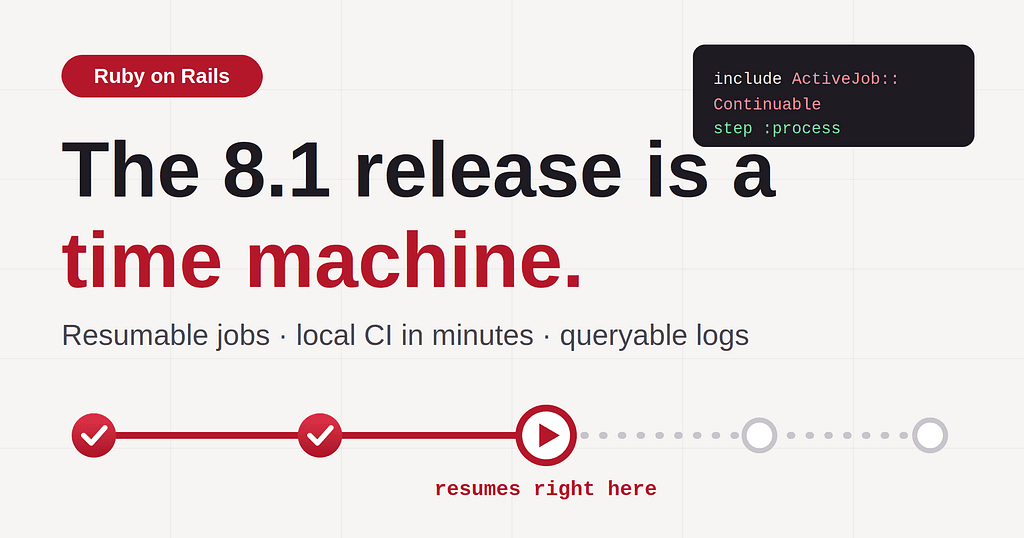
The Rails 8.1 fix: Jobs can now be broken into discrete, resumable steps. When a job is interrupted, it picks up from the last completed step — or even from a saved cursor position inside a step:
class ProcessImportJob < ApplicationJob
  include ActiveJob::Continuable
  def perform(import_id)
    @import = Import.find(import_id)
    step :initialize do
      @import.initialize
    end
    # A step with a cursor - position is saved on interruption
    step :process do |step|
      @import.records.find_each(start: step.cursor) do |record|
        record.process
        step.advance!
      end
    end
  end
end
Time saved: No more writing custom checkpointing logic, no more idempotency gymnastics, no more re-processing hours of work after every deploy. This is the kind of infrastructure code teams used to hand-roll (badly) — now it’s one include away.
2. Local CI — Kill the 15-Minute Feedback Loop
Here’s a workflow you’ll recognize: push code, wait for cloud CI, get distracted, come back 15 minutes later to a red build, context-switch back into the problem, fix, push, wait again. Repeat until despair.
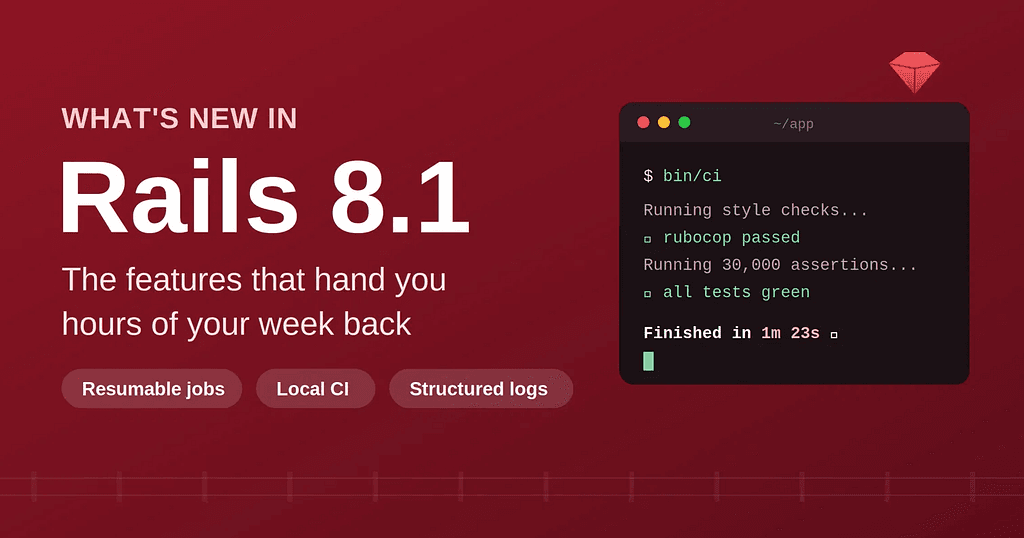
The Rails team looked at modern hardware and asked an obvious question: why are we waiting on the cloud at all? Dev machines today have tons of fast cores. As a reference point, the HEY test suite — over 30,000 assertions — used to take more than 10 minutes in cloud CI, and now runs locally in under 2.5 minutes on modern laptops and desktops.
So Rails 8.1 ships a CI declaration DSL. You define your pipeline in config/ci.rb and run everything with a single command:
bin/ci
Style checks, security scans, tests — one command, on your machine, in minutes.
Time saved: For small-to-mid-sized apps, you may not need a cloud CI setup at all. Even if you keep one, catching failures locally in 2 minutes instead of remotely in 15 changes your entire rhythm. Fewer context switches is the biggest productivity multiplier there is.
3. Structured Event Reporting — Logs You Can Actually Query
Rails’ default logs are lovely for humans and miserable for machines. If you’ve ever written regex to parse production logs into your observability tool, this one’s for you.
Rails 8.1 introduces a unified Event Reporter for structured events:
Rails.event.notify("user.signup", user_id: 123, email: "user@example.com")# Add tags
Rails.event.tagged("graphql") do
Rails.event.notify("user.signup", user_id: 123)
end
# Add context that applies to every event in scope
Rails.event.set_context(request_id: "abc123", shop_id: 456)
You register subscribers that decide how events get serialized and shipped — straight to Datadog, Splunk, or wherever your dashboards live. The feature was led by an engineer at Shopify, so it’s built with serious production scale in mind.
Time saved: Debugging production issues goes from “grep and pray” to querying structured, tagged, context-rich events. That’s hours per incident, and fewer incidents that drag on for days.
4. The Smaller Wins That Add Up
Rails 8.1 also ships a handful of quality-of-life features that quietly remove friction:
Built-in Markdown rendering. Rendering Markdown responses is now supported out of the box — handy for docs pages, AI-generated content, and content-heavy apps, with no extra gem plumbing.
Registry-free Kamal deployments. You can now deploy with Kamal without needing a remote Docker image registry for basic setups, and Kamal secrets can be read directly from encrypted Rails credentials. Fewer moving parts, fewer accounts, fewer things to break.
Command-line credentials fetching. Grab credentials from the CLI without opening an editor — great for scripts and deploy tooling.
Deprecated associations. You can now mark an Active Record association as deprecated, so usage gets flagged before you remove it. Refactoring large codebases just got safer.
Should You Upgrade?
If you’re on Rails 8.0 (or even 7.x with a recent Ruby), the upgrade path is reported to be straightforward. The usual advice applies: make sure your test suite is solid before you jump — which, conveniently, you can now run with bin/ci.
The theme of Rails 8.1 is clear: fewer external services, fewer hand-rolled workarounds, faster feedback. Background jobs that survive deploys, CI that finishes before your coffee cools, and logs your tooling can actually understand.
That’s not hype. That’s hours back in your week.
Are you running Rails 8.1 in production yet? I’d love to hear which feature saved you the most time — drop a comment below. And if this post helped, a few claps 👏 go a long way.
Tags: #RubyOnRails #Rails81 #WebDevelopment #Ruby #Programming