
How to Become an AI Engineer in 2026: The Complete Learning Roadmap
- artificial-intelligence
- ai-engineer
- mls
- machine-learning
- career-advice
A realistic, step-by-step path from complete beginner to job-ready AI Engineer — no fluff, no PhD required.
Artificial intelligence stopped being a “future skill” a long time ago. In 2026, companies of every size — from two-person startups to Fortune 500 enterprises — are hiring AI Engineers to build chatbots, autonomous agents, retrieval systems, and AI-powered products that real users depend on every day.
Here’s the good news: you don’t need a PhD or a research background to break in.
Here’s the honest news: the bar has gone up. In 2023, knowing Python and a bit of machine learning was enough to get interviews. In 2026, companies want engineers who can build reliable, production-ready AI systems — not just cool demos.
Most beginners fail not because AI is too hard, but because they follow random tutorials with no clear direction. This roadmap fixes that. It’s broken into five phases, takes roughly 8–12 months if you’re starting from scratch (faster if you already code), and focuses only on what actually gets you hired.
Let’s get into it.
First: What Does an AI Engineer Actually Do?
Before you learn anything, understand the job.
An AI Engineer is not a researcher training new models from scratch. That’s a different (and much rarer) career path. An AI Engineer builds practical applications on top of existing models. Think:
- A customer support chatbot that actually resolves tickets
- A search tool that finds answers across thousands of internal company documents
- An AI agent that automates a multi-step business workflow
- A recommendation system that knows what a user wants next
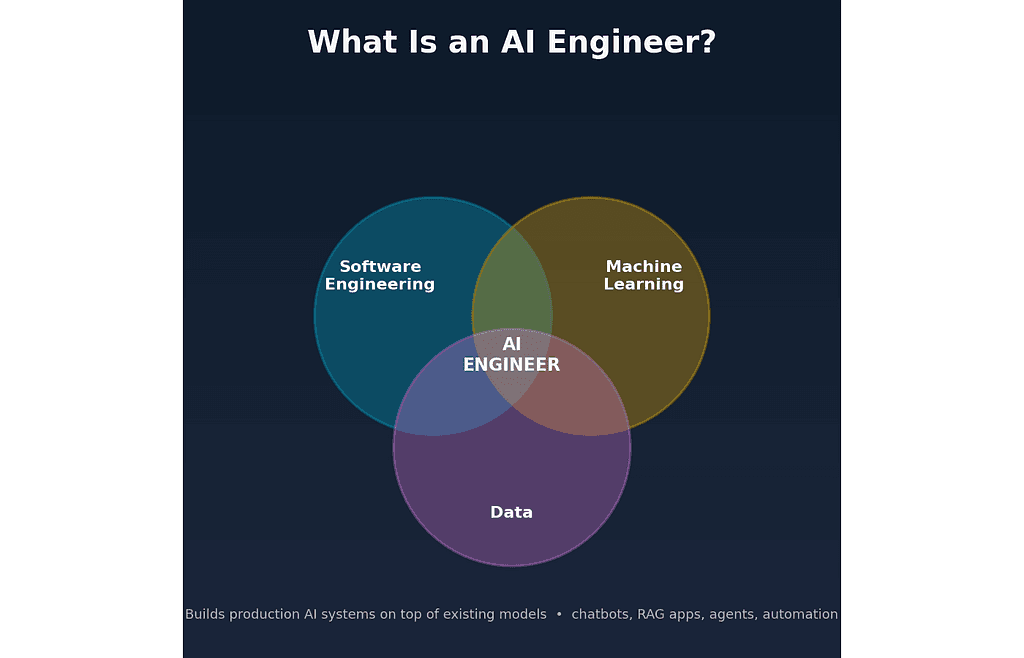
AI Engineers sit at the intersection of software engineering, data, and machine learning. You take powerful models (like Claude or GPT) and turn them into products people actually use. It’s building production software with AI at its core.
Salaries reflect the demand: depending on experience and location, AI Engineers in 2026 typically earn anywhere from $130K to $250K+ in the US market.
Phase 1: Programming Foundations (Months 1–3)
Everything in AI engineering runs on Python. This is the step you absolutely cannot skip.
What to learn:
- Variables, loops, conditionals, and functions
- Data structures: lists, dictionaries, sets, tuples
- Object-oriented programming (classes and methods)
- File handling and error management
- Working with APIs and JSON
- Git and GitHub (non-negotiable — every job requires it)
Free resources:
- Python for Everybody (Dr. Chuck) — the classic beginner course
- Automate the Boring Stuff with Python — free online book
- LeetCode / HackerRank easy problems for practice
Milestone project: Build a command-line app that pulls data from a public API (weather, movies, crypto prices) and saves results to a file. Push it to GitHub.
💡 Pro tip: Don’t get stuck in “tutorial hell.” The 80/20 rule: spend 20% of your time watching, 80% building.
Phase 2: Math & Machine Learning Fundamentals (Months 3–5)
You don’t need to be a mathematician, but you need enough intuition to understand why models behave the way they do.
Math essentials (keep it practical):
- Linear algebra basics: vectors, matrices, dot products
- Statistics: distributions, mean/variance, probability
- Calculus intuition: what a gradient is and why it matters
Machine learning core concepts:
- Supervised vs. unsupervised learning
- Regression, classification, and clustering
- Train/test splits and cross-validation
- Evaluation metrics: accuracy, precision, recall, F1
- Overfitting and how to fight it
Tools: NumPy, Pandas, Matplotlib, and scikit-learn.
Free resources:
- Andrew Ng’s Machine Learning Specialization (Coursera, free to audit)
- StatQuest on YouTube — the best ML explanations on the internet
- Kaggle’s free micro-courses
Milestone project: Take a Kaggle dataset (Titanic is the classic), clean it, train a few models, compare their performance, and write up your findings in a notebook.
Phase 3: LLMs, Prompt Engineering & RAG (Months 5–7)
This is where you enter modern AI engineering territory — and where most 2026 job descriptions live.
Working with LLM APIs:
- Calling models like Claude, GPT, and Gemini through their APIs
- Understanding tokens, context windows, temperature, and cost
- Structured outputs (getting reliable JSON from a model)
- Function calling / tool use — letting models take actions
Prompt engineering:
- System prompts vs. user prompts
- Few-shot examples and chain-of-thought techniques
- Prompt versioning and testing (yes, prompts are code now)
Retrieval-Augmented Generation (RAG) — the killer skill:
RAG is how you connect an LLM to your own data so it answers questions accurately instead of hallucinating. Nearly every enterprise AI product uses it.
- Embeddings and vector databases (Pinecone, Qdrant, Weaviate, or pgvector)
- Chunking strategies for documents
- Hybrid retrieval and reranking
- Evaluating RAG quality (tools like RAGAS)
Milestone project: Build a “chat with your documents” app. Upload PDFs, embed them into a vector database, and answer questions with citations. This single project teaches you 70% of what junior AI Engineer roles require.
Phase 4: AI Agents & Production Engineering (Months 7–10)
2026 is the year of agentic AI — systems that don’t just answer questions, but plan, use tools, and complete multi-step tasks autonomously. Job postings now routinely ask for it.
Agent skills:
- Agent frameworks: LangGraph, LangChain, or building from scratch
- Model Context Protocol (MCP) — the emerging standard for connecting AI to tools
- Multi-agent orchestration
- Memory and state management
- Guardrails and prompt injection defense
Production engineering (this separates good candidates from great ones):
- Deploying with FastAPI and Docker
- Cloud basics: AWS, GCP, or Azure
- Observability and monitoring (Langfuse, Phoenix, Helicone)
- Evaluation frameworks to catch quality regressions before users do
- Cost tracking and latency optimization
- CI/CD pipelines for shipping updates safely
Milestone project: Build and deploy an AI agent that automates a real workflow — for example, an agent that reads incoming emails, categorizes them, drafts replies, and logs everything to a dashboard. Deploy it live with monitoring.
Phase 5: Portfolio, Specialization & Job Hunt (Months 10–12)
Skills get you ready. Proof gets you hired.
Build a portfolio that shows production judgment:
Three polished, deployed projects beat ten half-finished notebooks. Aim for:
- A RAG application with real documents and citations
- An AI agent that automates something genuinely useful
- One project in a domain you care about (healthcare, finance, legal, e-commerce)
Each project should have: a live demo link, clean GitHub repo, clear README, and a short write-up explaining your decisions and trade-offs.
Specialize:
Employers in 2026 increasingly look for domain fluency. “AI Engineer who understands legal document workflows” is far more hireable than “generalist #4,000.”
Write about what you build:
Publish your project write-ups here on Medium or on a personal blog. It builds credibility, improves your communication skills, and recruiters genuinely read this stuff.
The job hunt:
- Optimize your LinkedIn headline: “AI Engineer | RAG • Agents • LLM Applications”
- Contribute to open-source AI tools (even documentation counts)
- Apply to startups — they hire on skills and portfolio, not credentials
- Practice explaining your projects out loud; system design questions about AI apps are now standard in interviews
Your 12-Month Roadmap at a Glance
Phase Timeline Focus 1. Programming Foundations Months 1–3 Python, Git, APIs 2. Math & ML Fundamentals Months 3–5 Statistics, scikit-learn, evaluation 3. LLMs & RAG Months 5–7 Prompting, embeddings, vector DBs 4. Agents & Production Months 7–10 LangGraph, MCP, deployment, monitoring 5. Portfolio & Job Hunt Months 10–12 Projects, specialization, applications
Common Mistakes to Avoid
❌ Trying to learn everything. A recent agentic AI job posting listed 25+ tools. Nobody knows all of them. Learn the fundamentals deeply; tools are learned on the job.
❌ Skipping software engineering. The #1 gap in 2026 candidates isn’t ML knowledge — it’s the inability to write clean, testable, deployable code.
❌ Building only demos. A demo that works once is not a product. Learn evaluation, monitoring, and error handling. That’s what “production-ready” means.
❌ Waiting until you feel “ready.” You will never feel ready. Build in public, ship imperfect projects, and iterate.
Final Thoughts
Becoming an AI Engineer in 2026 is genuinely achievable in under a year of consistent, focused effort — even starting from zero. The field rewards builders: people who ship real projects, understand trade-offs, and can turn a powerful model into a reliable product.
The roadmap is in front of you. The resources are free. The only variable left is consistency.
Start with Phase 1 today. Your future self — the one reviewing job offers next year — will thank you.
If this roadmap helped you, give it a clap 👏 and follow for more practical AI career guides. Comment below with which phase you’re starting from — I read every reply.
Tags to use on Medium: Artificial Intelligence, AI Engineering, Career Advice, Machine Learning, Technology